Your renewal date is not the only date your team needs
A renewal reminder helps only when the team knows what is due. Keep four dates apart, and carry the agreed term into billing.
By the Duebird team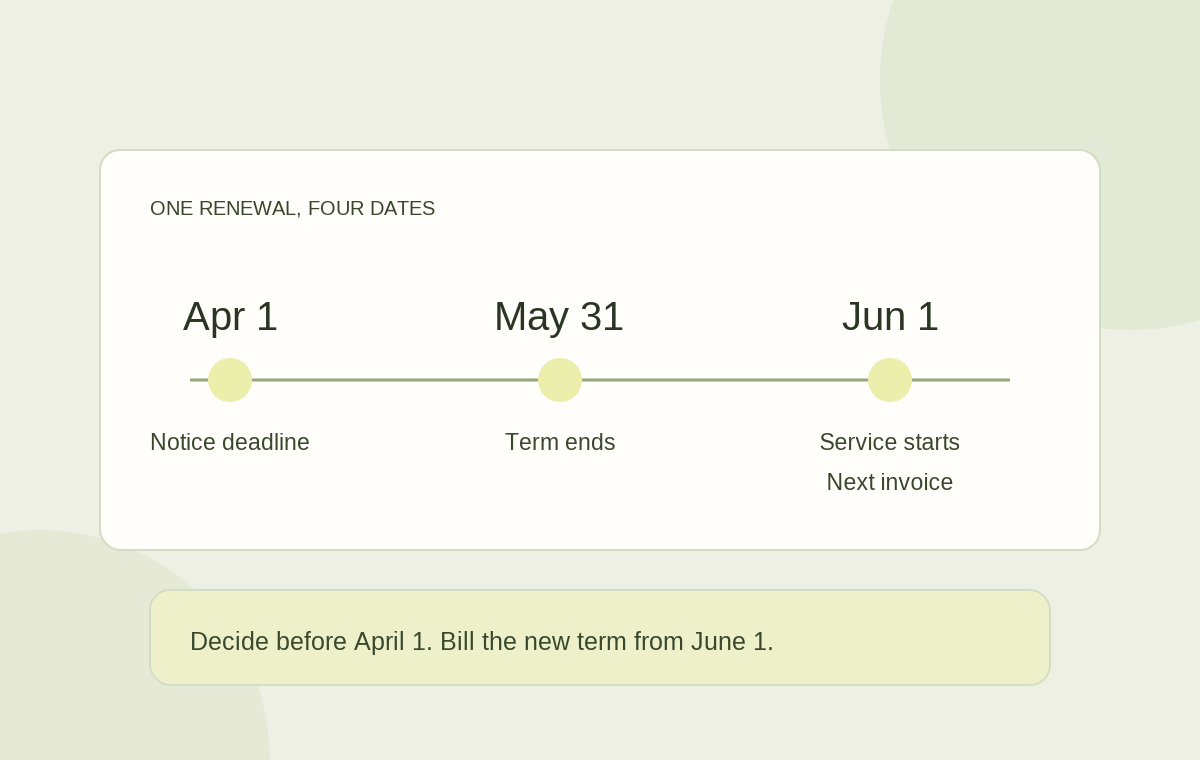
A renewal has four dates: the notice deadline, the current term end, the next service start, and the next invoice date. Give the decision before the notice deadline an owner, then carry the agreed terms into billing.
A renewal reminder is useful only when the team knows what action is due. Keep the notice deadline, current term end, next service start, and next invoice date separate. Give the commercial decision an owner, then carry the agreed next term into a billing schedule finance can review.
In this example, an annual subscription runs from June 1 to May 31, with 60 days’ notice to change or end it. The renewal conversation has to finish by April 1, not May 31.
Keep four dates separate
Each date answers a different question and moves for a different reason. Put them side by side for each renewal.
| Date | In this example | What sets it |
|---|---|---|
| Notice deadline | April 1 | The notice period in the agreement |
| Current term end | May 31 | The signed term |
| Next service start | June 1 | The renewal or new agreement |
| Next invoice date | June 1 | The billing terms for the next term |
You can review the renewals workflow with the contract date beside the account.
Assign the commercial decision
The decision before the notice deadline belongs to one person. Record who it is, where the customer stands, and the agreement version in force.
In a small team, the account manager and the billing owner may be the same person. Write down which decision is due anyway, so it is not lost between two roles.
Keep the agreement on file and manage customer agreements and renewals from the customer’s record.
Carry the renewed terms into billing
An accepted price or service change belongs in the next approved billing plan, from the date it takes effect. For example, a renewal at $52,000 from June 1 changes the quarterly charge to $13,000 from the first invoice of the new term.
Not every renewal is signed again, and some agreements renew on their own terms. Read the renewal clause, then confirm what the next invoice should say.
Before that invoice, review the next billing schedule against the renewed terms.
Use a renewal-to-billing checklist
Run the same short check for each renewal before its notice deadline.
- The customer entity and the agreement in force.
- The notice action and its deadline.
- Term end, next service start, and next invoice date.
- The renewed amount and any one-time changes.
- The billing review for the next term.
- The next customer contact and its owner.
Keep the renewal with the account history
Duebird keeps the next contract date, agreed terms, billing history, payment status, and customer conversation together. The person preparing the renewal can see what was billed and paid this term.
Notice rules come from the agreement and the law that governs it. Confirm them with your own advisers.
Track the notice deadline, term end, next service start, and next invoice date as separate dates. Give the decision before the deadline one owner.